Monday, July 13, 2009

Impartial Justice

Impartial Justice

Say among the nations, “YHWH is king! The world is firmly established; it shall never be moved. He will judge the peoples with fairness.” Psalm 96:10

I make no claim to be an expert in politics but as I was reading on MSNBC.com about Sonia Sotomayor, who could very well be the first Hispanic on the Supreme Court, I couldn’t help but reflect on her pledge to serve the “larger interest of impartial justice.” Republicans have questioned her impartiality while Democrats have praised her for being a Hispanic pioneer. It very well appears that she will get the position.[1] Since we are humans that do not always remain impartial, we do not always trust that others will remain impartial as well.

I will not vote for, and no senator should vote for an individual nominated by any president who believes it is acceptable for a judge to allow their own personal background, gender, prejudices or sympathies to sway their decision (Sen. Jeff Sessions of Alabama).

Who is the one that will always judge in fairness? Who is the one that judges impartially? The writer of this psalm says it is YHWH; the Lord that Scripture says is the creator of all, king of all, and judge of all. However, YHWH is not like other judges, kings, or people who may or may not judge impartially. The Bible says that the Lord is just and will right the wrongs of this world (creation, and humans). There will come a day when the Lord will deal with injustice.

He (YHWH) shall judge between the nations,

and shall arbitrate for many peoples;

they shall beat their swords into plowshares,

and their spears into pruning hooks;

nation shall not lift up sword against nation,

neither shall they learn war any more (Isaiah 2:4).

Who will deal with injustice? Who can we trust to be an impartial judge? Proclaim to the nations that the Lord is King! He is the one who will deal with injustice. It may seem like there is little hope for justice. It may seem like there are few if any (even within God’s people) to trust, but the Lord is the one to trust. We may have our doubts about people and how they judge but know that there is no doubt that God will judge impartially. This message is desperately needed in today and tomorrow’s world. Just read the world headlines and you will see people who are desperate for someone to bring justice. I conclude with this passage from the prophet Isaiah, who was prophesying of the coming Messiah of God.

He shall not judge by what his eyes see,

or decide by what his ears hear;

but with righteousness he shall judge the poor,

and decide with fairness for the meek of the earth;

he shall strike the earth with the rod of his mouth,

and with the breath of his lips he shall kill the wicked.

Righteousness shall be the belt around his waist,

and faithfulness the belt around his loins.


[1] Whether or not Sonia Sotomayor will be an impartial judge is not my point here. There are places to read up on the opinions of both sides. See your favorite news website for starters.

Wednesday, July 1, 2009

Reflections from the way of the cross Part 3


Two Trails

“. . . the end of those things is death . . . the end is eternal life.” The Apostle Paul

There are multiple trails that lead out of Campus by the Sea. About the middle of the week family campers (who choose to) go off on a trail that leads to the tourist town of Avalon. The campers know that if they stay on the trail they will “end” up in Avalon. It is inevitable. There is another trail, a much short one (one I prefer), that ends up at the “way of the Cross.” This way too is inevitable. A camper will not go to the trail that leads to Avalon and expect to “end” up at the “way of the Cross.” One trail leads to one place and the other trail leads to another. This is what is expected. The Apostle Paul says that if one presents oneself “as slaves to impurity and to greater and greater iniquity” their “end” is death, but the one who presents oneself “as slaves to righteousness for sanctification” their “end” is life. This is their end result. The outcome of the life that is devoted to one way or the other will result in one of two things.


Paul concludes chapter 6 of Romans saying, “For the wages of sin is death, but the free gift of God is eternal life in the Messiah Jesus our Lord” (verse 23). We choose one trail or another but this path of life is made possible by us being in the Messiah Jesus our Lord. We have died and have risen to new life (Romans 6) and we await the day of our own resurrection.

Thanks for reading

Marcelino


What Happens After You Die?

N. T. Wright on what happens after we die. He speaks of new creation and the resurrection of our bodies. This is a short video of some of the things I have been writing about.

Sunday, June 28, 2009

Reflections from the way of the cross Part 2


“A transformed family is a family centered around the gospel of God’s grace in Jesus Christ.”

Tim Theule, Pastor of Grace Church San Luis Obispo

“Do nothing from selfish ambition or conceit, but in humility regard others as better than yourselves.” The Apostle Paul

This past week of family camp was excellent as I have already stated in my previous blog. Pastor Tim spoke on the life of Paul this past week of family camp. He is one of the best speakers that I have heard. He is great on speaking profound theological truth and at the same time being very practical in his illustrations and application. I said in my previous blog, “I love to hike up the “way of the cross” because it gives me a bigger perspective. In my own little world, which consists of me and my salvation, I can get consumed with myself, but when I come up to the cross I can see where human redemption meets creation’s redemption.” The cross gets us to think of more than ourselves. Or as Pastor Tim would say it “the Gospel of God’s grace” is what gets us to think of our families, friends, enemies, and yes creation as well.

The Apostle Paul also wrote in his letter to the Philippians that they too were to think of others and to move past their own selfish ambitions. Philippians 2:5-11, which is a profound Christological passage but if not for the situation that arouse in Philippi it may have never been written. We are to live a selfless life with others especially in our families. Pastor Tim was very insightful in saying that Paul was always looking how to apply the Gospel in every situation. We never get past it and we always need to look to the Gospel. Understanding the significance of the cross and for that matter the resurrection never gets old, as Paul shows in Philippians 2:5-11. How much could people’s marriages and families be transformed with understanding the reality of the Gospel of God’s grace? Many marriages today need to hear the message of the selflessness of Jesus Christ. I could go on but I think you get the picture.

Coming home and hearing the message Pastor George spoke on Sunday at Living Water Foursquare was helpful in continuing of God drawing me further into this selfless life that moves me past my own selfish ambition. Again, this is what the Gospel does. “PG” mentioned how some live on the surface of being Christian. This I find perplexing, which I am sure Pastor George would agree. What has gone wrong? I find “living on the surface” highly unlikely if families are “centered around God’s grace.” Christianity is not a “fire insurance” faith but a Gospel centered faith. I will finish this blog by concluding with the Apostle Paul’s great and profound Christological statement but at the same time very applicable to Christians and families as well. Let’s make it our prayer!

Let the same mind be in you that was in Christ Jesus,

who, though he was in the form of God,

did not regard equality with God

as something to be exploited,

but emptied himself,

taking the form of a slave,

being born in human likeness.

And being found in human form,

he humbled himself

and became obedient to the point of death—

even death on a cross.

Therefore God also highly exalted him

and gave him the name

that is above every name,

so that at the name of Jesus

every knee should bend,

in heaven and on earth and under the earth,

and every tongue should confess

that Jesus Christ is Lord,

to the glory of God the Father.

Saturday, June 27, 2009

Reflections from the “way of the Cross” Part 1


“In the Bible, salvation is not God’s rescue of people from the world but the rescue of the world itself.” N. T. Wright

“That the creation itself will be set free from its bondage to decay and will obtain the freedom of the glory of the children of God.” The Apostle Paul

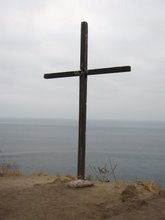
I am sitting here up on a hill on Catalina Island, overlooking the Pacific Ocean and the cross of Jesus (I wrote this when I was at Campus by the Sea). I am reminded that God is both Creator and Redeemer but these two are closer than we think. In Romans 8:21 (quoted above) Paul reminds us of this truth. We as humans receive from the cross of Jesus and his resurrection the redemption of our bodies (Romans 8:24). But we share this redemption with creation! I am in awe of this great plan of redemption. As I am sitting looking at the cross, which overlooks God’s creation, I realize that the cross will redeem this creation. Yes, it is true! God’s creation will obtain the very redemption that we will obtain!

I love to hike up the “way of the cross” because it gives me a bigger perspective. In my own little world, that consists of me and my salvation, I can get consumed with myself, but when I come up to the cross I can see where human redemption meets the creation’s redemption. What is the redemption of our bodies? What is the redemption of creation? How does this change how we live our lives today? This is nothing short of the renewal/rescue of all things! We are not being rescued from creation but God is going to rescue creation itself! God is going to put things in order that was once in disorder. Humans as well as creation are in disorder! They both long together for their redemption. Know that the cross and Jesus’ resurrection makes all things new!

“He has made known to us the mystery of his will, according to his good pleasure that he set forth in Christ, as a plan for the fullness of time, to gather up all things in him, things in heaven and things on earth.” The Apostle Paul

Father,

Help us by your Spirit to see the big picture and to live as if your new creation has started (which it has in your Son’s death and resurrection) and help us to see that we have a part to play as your stewards of your creation!

I ask this in the name of Jesus Christ, your Son, who lives and reigns with you and the Holy Spirit. One God forever and ever, Amen!

Saturday, June 20, 2009

Conversion a process, at a moment in time, or both? Why should I care?

I want to begin by stating that this blog or note is directly and also indirectly influenced by Body, Soul, and Human Life: The Nature of Humanity in the Bible by Joel Green (professor of New Testament interpretation at Fuller Theological Seminary) and also through reflecting on lectures from my Medieval and Reformation Church History course by “Mel” Robeck. My seminary experience has profoundly influenced and challenged me but not merely intellectually or academically but spiritually as well. I have come to learn that to try and separate the two (intellect and spiritual) is virtually impossible. Now on to what I want to write about and that is conversion.

I have often thought of conversion as strictly happening at a moment in time. I am not saying that all Christians think like this but in my experience and in my tradition this was the case. I prayed “the sinners’ prayer” at age 16 and it was then that I was “converted” or I became a “convert.” At that moment, I became a “born again” Christian. After that God continued to use others in my life to help grow my young faith. These were and still are moments I look back on and see God at work in my life. I am very thankful for God working in my life and I am very thankful for the people God put in my life. But as I look at my life, I see God working even before I prayed “the sinners’ prayer.” Was this God working in my life in anticipation or preparation for the moment I became a convert? Or was I already in the process of being spiritually formed? Or another way to put it, did I have “enough” knowledge and trust in God and therefore already was a convert? How do we define a convert? Defining a convert may be a good way to start. Joel Green’s definition fits well here. “. . . one who has undergone a redirectional rotation and is on the move in faithful service to the purpose of God as this is revealed in Jesus Christ and underwritten by the Spirit of God.”[1] This “redirectional rotation” is not only the process of conversion but of repentance, which is closely linked to conversion. Peter says, “Repent and be baptized” (Acts 2:38). Also John the Baptist ministry consists of turning the people of Israel to God.

He will turn many of the people of Israel to the Lord their God. 17 With the spirit and power of Elijah he will go before him, to turn the hearts of parents to their children, and the disobedient to the wisdom of the righteous, to make ready a people prepared for the Lord (Luke 1:16-17).

We can see that John’s ministry as well as the message of Luke-Acts as a whole that repentance as Joel Green puts it is “aimed at a transformation of day to day patterns of thinking, feeling, and believing.”[2] This type of transformation happens over a period of time but this does not deny the key spiritual moments that are valuable to our spiritual formation.

Is there a difference between conversion and repentance? I once thought conversion had to do with the changing of one religion to another and repentance included the changing of one religion to another but also can include the repentance within one’s religion. A closer look at Luke-Acts in particular shows that both Jews and Gentiles are called to repentance and conversion. “God has given even to the Gentiles the repentance that leads to life” (Acts 11:18). “God exalted him at his right hand as leader and Savior that he might give repentance to Israel and forgiveness of sins” (5:31). Green also notes, “he (Luke) characterizes conversion as the movement from darkness to light.”[3] In Luke-Acts Jews and Gentiles are called to come out of the darkness and into the light. Paul says that he was sent “to open their eyes so that they might turn from darkness to light and from the power of Satan to God” (Acts 26:17-18; see also Luke 1:78-79). Conversion in Luke-Acts is a “redirectional rotation” but this is a process of learning how to be a member of a community that is fully reliant on the saving work of Jesus Christ. This is seen with the disciples’ lack of immediately understanding the mission of Jesus. They even had a wrong understanding of the bodily resurrection of Jesus Christ. “They were startled and terrified, and thought that they were seeing a ghost” (Luke 24:37). Also Peter and the Jerusalem Church had to learn that the Gentiles are also apart of God’s community and Jesus is “Lord of all.” “The circumcised believers who had come with Peter were astounded that the gift of the Holy Spirit had been poured out even on the Gentiles” (Acts 10:45). This does not deny that Peter and the disciples were not in some sort of process of sanctification but at the same time the above should show that meaning of conversion is expanded in Luke-Acts.

Now in regards to my own conversion, I do not think that I became a convert at age 16 when I prayed “the sinners’ prayer.” As a young Catholic, I was very much looking at how I might fulfill my purpose within God’s redemptive plan. I had a very limited understanding. I did believe that Jesus died for me and that he was raised from the dead. Did I understand the full significance of that? No. Will I ever in this life understand the full significance of his death and resurrection? No. It is a process of learning, believing, and growing within the community of God. One final quote from Joel Green, “Conversion is a journey, not an instantaneous metamorphosis; even though points of decision-making can be traced in the Lukan narrative, these provide points of beginning and milestones along the way, rather than conclusion.”[4] I have come to realize that my journey of conversion began long before praying “the sinners’ prayer.” But at the same time I want to affirm that praying that prayer was a significant milestone in my spiritual formation. More could be said here but this should at least be a good start to get us thinking about how this might change how we evangelize and disciple people.

Thanks for reading,

Marcelino


[1] Joel Green, Body, Soul, and Human Life: The Nature of Humanity in the Bible(Grand Rapids, Michigan: Baker Academic, 2008), 137.

[2] Ibid., 123.

[3]Ibid., 134.

[4] Ibid., 137.

Saturday, June 13, 2009

Knowing Christ, the Uniting Factor

Knowing Christ is essential for any and all Christians. For the Apostle Paul, it was the uniting factor between Jews and Gentiles. They had various customs and rituals but all that did not matter, for God in Christ has made them both a new humanity (Ephesians 2:15). The Apostle Paul also says, “For neither circumcision nor uncircumcision is anything; but a new creation is everything” (Galatians 6:15). Paul speaks of how the Church of Ephesus (Gentiles in particular) did not remember Christ, as they had learned him. They needed to be reminded that they were a new humanity (Ephesians 2:15) and that they were called to live a new moral life (See Ephesians 4:17-24). Jews and Gentiles together are “created according to the likeness of God in true righteousness and holiness” (Eph. 4:23). This is how they have come to know and learn him through apostolic teaching and through their own relationship with him corporately and personally.

Does the Church, which appears to be divided today, need to hear this uniting message? I would say that this message absolutely needs to be heard. This message of unity involves being truly the community of God. This community works together to figure out how to live out what it means to be God’s workmanship, all the while remembering how we have learned Christ. So knowing Christ unites Christians from different traditions to encourage and enable each other through the knowledge of Christ to be the new creation and humanity that God has made them to be in Christ Jesus. It is the uniting factor.

Richard Mouw (President of Fuller Theological Seminary) spoke to 400 plus graduates on June 13, 2009. The graduates consisted of people from all kinds of Christian denominations and traditions. He “charged” them all with the same message of “knowing Jesus.”This is what unites us as Christians. Time after time even in my own life, I have looked at the differences that I had with other Christian traditions. I have since been challenged to look not at what divides us but at what unites us as Christians. A lot more could be said on this topic and I do think differences need to be looked at but we need to be careful not to jeopardize a united community of Christians.

Thanks for reading,

Marcelino